Your chatbot answered the customer in two seconds flat. Then the customer asked to book, and it said "please call us during opening hours." So they called. Nobody picked up. Reply received, booking lost.
That gap, between answering and actually doing, is the whole difference between a chatbot and an AI Agent. And it's the difference most operators only notice when they count the bookings that slipped through.
What a chatbot actually does (and where it stops)
Let's be fair to the chatbot. It talks. It greets the customer, answers a frequently-asked question from a script, maybe sends a link. For simple deflection on a webpage, that's genuinely useful.
The problem is where it stops. A chatbot is a conversation that ends at the exact moment the customer wants to act. You know the dead-ends because you've read them in your own chat logs:
- "Please call us during opening hours."
- "Fill in this form and our team will get back to you."
- "I'm not able to help with that."
The reply lands. The job doesn't get done.
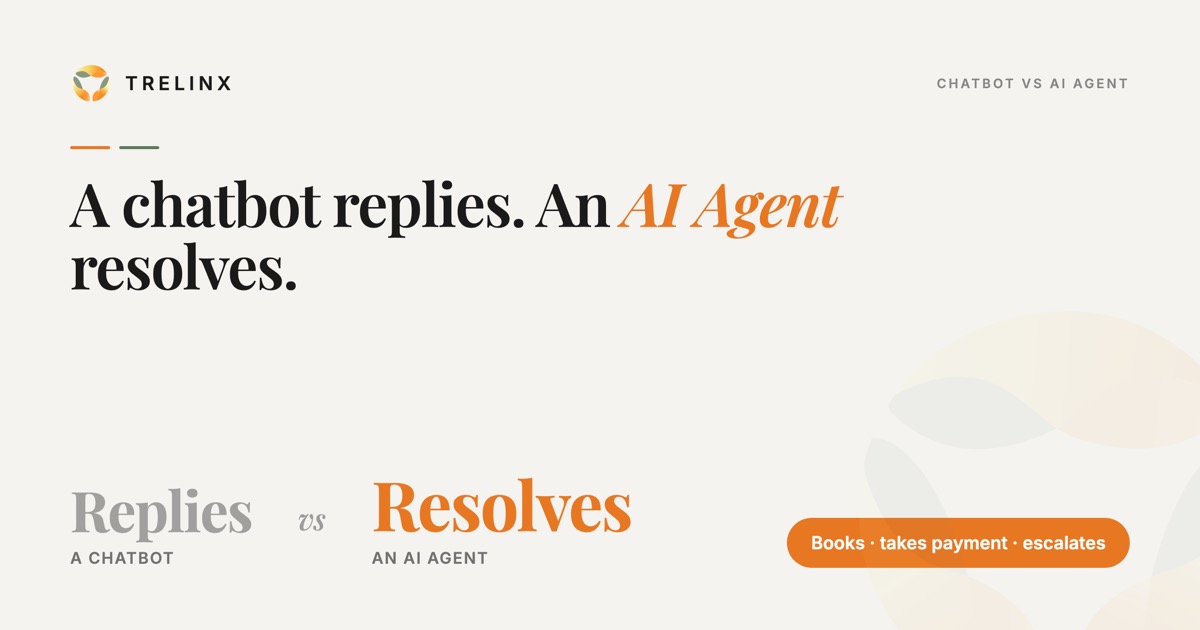
A chatbot replies: answers an FAQ, sends a link, then "please call us." Conversation ends, action doesn't.
An AI Agent resolves: books the slot, takes the deposit, escalates with the full conversation. Conversation ends, job done.
What an AI Agent does differently: it acts
An AI Agent is the part that finishes the job inside the same conversation. Concretely, that's four things a chatbot can't do:
- Books the appointment. Checks real-time availability and locks in the slot mid-conversation, then reschedules if plans change. No "call us back."
- Takes the deposit. Sends a payment link and collects the deposit there and then, on the call or over WhatsApp, so the booking is real, not just pencilled in.
- Escalates with context. When a human is genuinely needed, it hands over the whole conversation plus an AI-written summary. The customer never starts from scratch.
- Acts on your systems. Checks stock, looks up a customer, confirms an address. It does the small operational tasks mid-conversation, not after a form.
The shorthand: a chatbot replies, an AI Agent resolves.
Voice-first, not just a chat widget
Most chatbots live in a text box on a website. But Singapore SME customers still pick up the phone, and that's where the bookings actually leak. A Trelinx AI Receptionist is voice-first by design: it picks up on the second ring, 24/7, in Singlish and 15+ languages on voice, with WhatsApp as an add-on (English, Singlish, Mandarin, Malay). It's not a fancier text bot. It's the same brain, answering the channel your customers actually use.
Why this matters more when you run multiple outlets
A single front desk can paper over a dumb chatbot, because there's a human nearby to catch what it drops. Run multiple outlets and the gaps multiply. Every location's enquiries land at the same peak moments, after hours, on weekends, and a chatbot that only replies just moves the bottleneck somewhere quieter.
A multi-outlet SME operator needs every enquiry to actually convert into a booking, a lead, or a deposit, without adding a person at each counter. An AI Agent does that, and logs every conversation to one dashboard across all your outlets, so you can finally see what customers are calling about at scale.
Fully automated, but not a brick wall
The fear with anything automated is the loop: the customer trapped with a bot, mashing "0" to reach a human who never comes. That's not the model.
A Trelinx AI Receptionist is fully automated end-to-end by default, with an optional human path. The caller can ask for a person any time, or the agent itself flags when something should go to a human, and crucially, the human picks up with the entire conversation and an AI-generated summary in hand. Nobody has to repeat themselves. Automated by default, human on tap.
So which do you actually need?
Quick gut-check, no sales pitch. If all you need is to answer FAQs on a webpage, a chatbot is fine, keep it. But if a missed action means a missed booking, and for a multi-outlet operator it almost always does, you need something that acts, not just answers. When you want the side-by-side, see the full head-to-head.
FAQ
What's the difference between a chatbot and an AI Agent?
A chatbot talks: it answers FAQs and sends links, then stops when the customer wants to act. An AI Agent acts: it books the appointment, takes the deposit, and escalates to a human with the full conversation in hand, all in the same chat or call. One replies; one finishes the job.
Can an AI Agent actually book an appointment and take a deposit?
Yes. A Trelinx AI Receptionist books the slot against real-time availability and sends a payment link to collect a deposit mid-conversation, on voice or WhatsApp. The customer doesn't get bounced to "call us back" or "fill in a form."
Is an AI Agent just a chatbot for phone calls?
No. It's voice-first by design: it picks up on the second ring, 24/7, in Singlish and 15+ languages on voice (WhatsApp covers four: English, Singlish, Mandarin, Malay). Same intelligence, answering the channel your customers actually use, then acting on what they ask for.
If it's automated, does the customer get stuck talking to a bot?
No. It's fully automated by default with an optional human path. The customer can ask for a person, or the agent flags when it should hand over, and the human picks up with the whole conversation plus an AI-written summary. Nobody has to repeat themselves.
Why does this matter more for a multi-outlet operator?
With multiple outlets, enquiries spike at the same peak moments across every location, after hours and on weekends. A chatbot that only replies just moves the bottleneck. An AI Agent captures the booking, the deposit and the lead at every outlet without adding headcount, and logs it all to one dashboard.
Sources
- Capability claims (books, takes deposit, escalates with full context and AI summary, custom tool execution, second-ring pickup, 24/7): Trelinx Product Features Catalogue (Voice, Tooling, Platform).
- Language split (Voice: Singlish + 15+ languages · WhatsApp: English, Singlish, Mandarin, Malay): PRICING v1.7 §4.5.
- "Fully automated end-to-end by default, with caller-requested transfer and optional human-in-the-loop": PRICING v1.7 §4.2.
- Multi-outlet command centre and one-dashboard logging across outlets: Product Features Catalogue (Platform); PRICING v1.7 §4.3.
- The "reply received, booking lost" example is illustrative, not a measured statistic.