The offshore quote lands and it looks great. Two, three, sometimes four times cheaper than a Singapore agent. On paper, easy. But the quote is the easy part.
What the quote doesn't show is the part that actually decides this: the 4-to-8-week ramp you pay for before anyone's productive, the after-hours hole someone still has to fill, and the awkward truth that your customers' data crossing a border doesn't move the PDPA accountability off your desk. It stays yours.
None of this means offshore is wrong. It means the price tag isn't the decision. Here's what is, for a multi-outlet SME operator running multiple outlets.
What the quote shows: a low hourly seat rate, "24/7 available" in the deck, "fluent English" agents, a neat monthly number.
What it actually costs you: a 4 to 8 week ramp before they're productive, extra headcount for genuine after-hours cover, "neutral English" not Singlish, and PDPA accountability that never leaves Singapore. Yours.
1. The timezone and after-hours gap
An offshore seat covers a shift, not the clock. A single dedicated agent works business hours. To genuinely cover round-the-clock, you're not paying overtime, you're stacking shifts, which means more headcount. Extended after-hours cover (roughly 1.5 agents) lands somewhere around S$4,000 to S$4,500 a month (illustrative), and true 24/7 needs four or five agents, so it costs materially more than that.
Meanwhile your customers don't call on a schedule. They call during the Friday dinner rush, on Sunday afternoon, at 11pm when they remember they need to reschedule. Across multiple outlets, those calls all land at once. The enquiry that sits unanswered until Monday morning has usually booked somewhere else by then. An AI Receptionist answers on the second ring, every outlet, around the clock, with no shift to staff and no handover gap.
2. Language, and the "neutral English" problem
Offshore call centres coach agents toward "neutral English," accent-neutralised for international markets. That's a real, standard part of their training. What none of them coach is Singlish, the local rapport your customers actually expect on the phone. When intelligibility slips, you get more repeats, more clarifications, and more "sorry, can you say that again," which quietly drags every call out longer.
Tamil is the same story. SME-priced Tamil voice in the Singapore register is hard to source offshore. India offers an Indian-register Tamil, Malaysia offers it at a premium tier, but for a Singapore SME it's rarely cheap or local-sounding. An AI Receptionist speaks Singlish natively, plus 15+ languages on voice (WhatsApp covers four: English, Singlish, Mandarin, Malay).
3. PDPA and data residency: the accountability that stays yours
This is the one most operators underweight. The moment you route call-handling overseas, your customers' personal data crosses a border. Under Singapore's PDPA Transfer Limitation Obligation, your business has to ensure the overseas party gives comparable protection, and a Data Transfer Agreement is how you do that on paper.
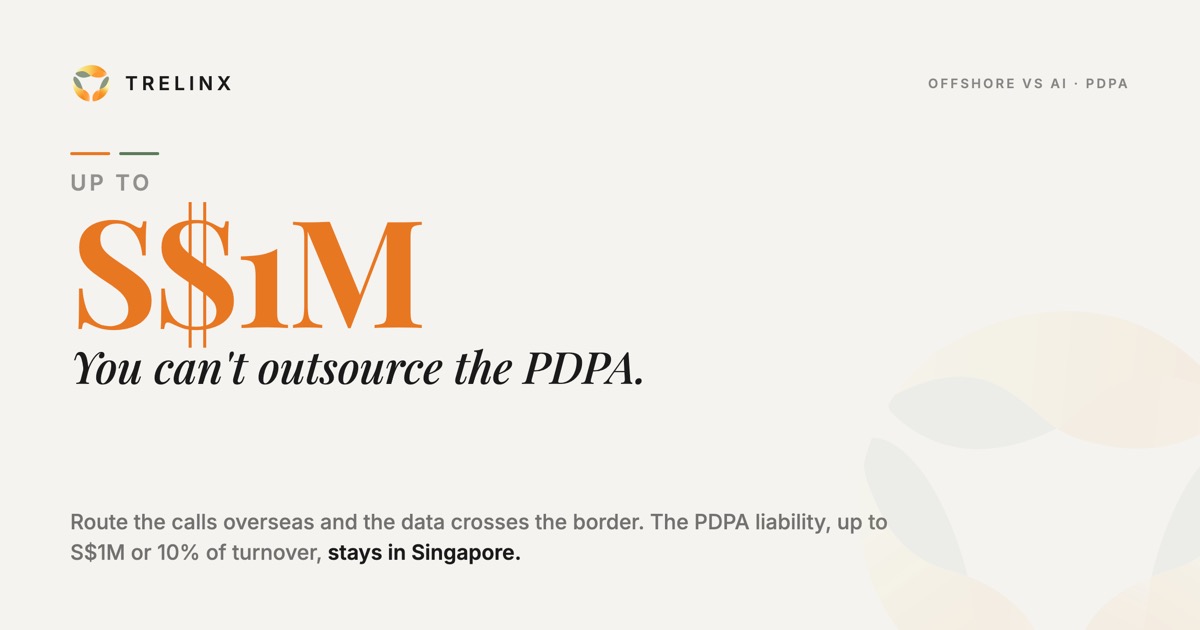
Here's the catch: a DTA shifts contractual responsibility, not regulatory accountability. If there's a breach, your organisation is still the one answerable to the PDPC. Exposure runs up to S$1 million, or 10% of annual Singapore turnover for larger organisations (turnover above S$10M), whichever is higher. Setting up the cross-border agreement is a few thousand dollars in one-off legal, more if it's bespoke. An AI Receptionist is hosted in Singapore with PDPA built in, so the data, and the liability that travels with it, never leaves the country.
4. The onboarding ramp you pay for before anyone's productive
An offshore agent doesn't start at full speed. The standard ramp runs 4 to 8 weeks before they're fully productive: partial output earlier, full performance somewhere around week eight. You're paying salary and the seat through all of it. For a multi-outlet operator, that clock resets with every new hire and every replacement.
A Trelinx AI Receptionist goes live in days, not months. A demo runs in about a week, a simple deployment in around three, and it's consistent from the very first call.
5. Consistency and the quality tax
Call-centre attrition is high. Every agent who leaves resets the ramp clock and takes your brand knowledge with them. Quality drifts across agents, shifts, and outlets, so your Tampines branch ends up answering differently from your Jurong one. And the "cheap" quote rarely stays cheap: a 3 to 5% annual rate escalation is a standard clause in outsourcing contracts.
An AI Receptionist gives the same answer at every outlet, on every shift, with no attrition and no re-training. It's fully automated by default, with an optional human path for the genuinely hard calls. Inconsistency erodes customer trust quietly, long before it shows up in a churn number.
The pattern across all five: offshore is priced like a seat, but it bills you like a system. The seat is the cheap part. The gaps, the ramp, the compliance, and the drift are the real invoice, and most of it never appears on the quote.
So, offshore or an AI Receptionist?
Offshore can still make sense for some operations. But for a Singapore multi-outlet SME operator weighing it honestly: the quote hides the after-hours gap, the Singlish gap, the PDPA accountability that never leaves your desk, the ramp you pay for, and the consistency tax. An AI Receptionist closes those gaps. It answers 24/7 across every outlet, in Singlish and 15+ languages, keeps your data in Singapore, goes live in days, and sounds the same on every call. When you want the line-by-line, see the full head-to-head.
FAQ
Is an offshore call agent cheaper than an AI Receptionist for a Singapore business?
On the quote, offshore can look cheaper. Singapore in-country agents run roughly 2 to 4 times offshore rates. But the quote leaves out the 4 to 8 week ramp you pay for, the after-hours gap (true 24/7 needs multiple shifts, not one agent), and a standard 3 to 5% annual rate escalation. An AI Receptionist covers 24/7 across every outlet at a published rate (S$488/mo platform plus S$0.30/min voice), with no headcount to ramp.
Do offshore call agents understand Singlish?
Generally no. Offshore call centres coach "neutral English" or accent-neutralisation for international markets, not Singlish. SME-priced Tamil voice in the Singapore register is also hard to source offshore. A Trelinx AI Receptionist handles Singlish natively, plus 15+ languages on voice.
If I outsource calls overseas, who is responsible under PDPA if there's a breach?
You are. Under the PDPA Transfer Limitation Obligation, the Singapore organisation stays accountable to the PDPC even with a Data Transfer Agreement in place. A DTA shifts contractual, not regulatory, liability. Exposure runs up to S$1 million, or 10% of annual Singapore turnover for larger organisations (above S$10M), whichever is higher. An AI Receptionist keeps the data in Singapore.
How long before an offshore call agent is productive?
Typically a 4 to 8 week ramp before they're at full productivity, and you pay through that gap. For a multi-outlet operator it resets with every new hire and replacement. A Trelinx AI Receptionist deploys in days (a demo in about a week, a simple deployment in around three) and is consistent from the first call.
What's the difference between an offshore call agent and an AI Receptionist?
An offshore agent is outsourced human headcount on a shift: billed per seat, ramped over weeks, coached in neutral English, with your data crossing a border. An AI Receptionist answers every call 24/7 across every outlet, in Singlish and 15+ languages, with Singapore data residency, fully automated by default and an optional human path.
Sources
- SG vs offshore agent rates (~2-4x): FlyFone SG (SG S$18-40/hr vs Philippines S$8-15/hr), corroborated by Call Force Global and Crescendo.ai (2026).
- Offshore all-in cost band (illustrative, ~S$2,000-3,500/mo): Call Force Global, Crescendo.ai, PITON-Global TCO (2026). Illustrative model, not a quoted price.
- Standard 3-5% annual rate escalation clause: CPI-escalation contract guidance (fynk, ContractKen, Icertis, Sirion).
- Onboarding ramp 4-8 weeks: Articulate, HiveDesk, LeadAdvisors (2026 BPO onboarding norms).
- "Neutral English" / accent-neutralisation training: PITON-Global, Creathink Solutions.
- PDPA penalty (up to S$1M or 10% of SG turnover, whichever higher): PDPC, Allen & Gledhill, DLA Piper.
- Transfer Limitation Obligation, DTA shifts contractual not regulatory liability: PDPC Transfer Limitation guidance (s26).
- Trelinx coverage, languages, data residency, deployment, and pricing (S$488/mo platform · S$0.30/min voice): published rate card (PRICING v1.7). Offshore cost figures are illustrative ranges, not claimed averages.